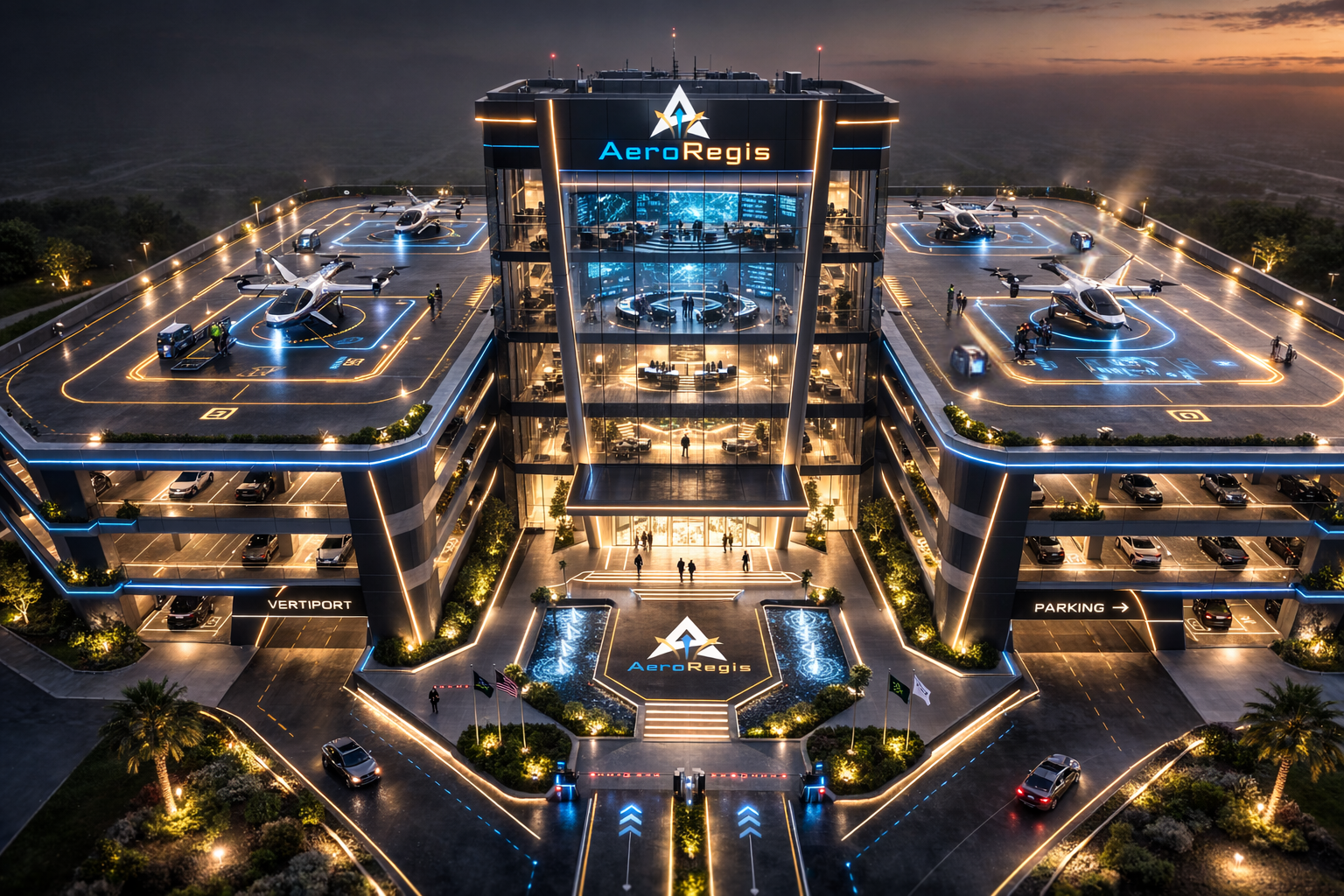
The aircraft needs somewhere to land.
AeroRegis doesn't just coordinate aircraft in flight — it governs the full operational lifecycle of every vertiport it manages. Flight scheduling, pad sequencing, passenger flow, real-time telemetry, and emergency protocols run through a single integrated command layer. The physical and digital infrastructure are inseparable by design.
Site Selection & Construction Oversight
AeroRegis conducts site feasibility analysis, zoning alignment, and airspace corridor compatibility assessments before a single dollar is committed to ground. Third-party construction is coordinated and overseen against AeroRegis operational specifications — ensuring what gets built is what the operations require.
- Site feasibility & corridor analysis
- Infrastructure specification development
- Third-party construction coordination
- Pad layout, charging & terminal design oversight
- Commissioning and certification support
Simulate Before You Build.
Before construction begins, AeroRegis deploys digital twin modeling of your vertiport and air corridors. Cities evaluate traffic density, throughput limits, emergency response procedures, and congestion scenarios — virtually — eliminating costly build-then-discover infrastructure decisions.
- Vertiport traffic & throughput modeling
- Corridor congestion scenario testing
- Emergency response procedure simulation
- Infrastructure placement optimization
- Data-driven planning for city council approval
AURA — Your City's Digital Co-Controller.
AURA (Autonomous Urban Routing Assistant) is the AI layer that makes high-density urban air corridors manageable at scale. It operates as a real-time decision-support system for Urban Air Traffic Controllers — deconflicting routes, flagging safety events, and modeling congestion before it occurs.
- Real-time route deconfliction
- Predictive congestion modeling
- Automated flight plan validation
- Intelligent safety alerting
- Scales controller capacity without adding headcount
Jobs That Exist Before the Aircraft Arrive.
AeroRegis builds the talent pipeline in parallel with infrastructure. Through university partnerships and local-based Academies, cities gain a certified local workforce ready for day-one operations — not a dependency on out-of-market talent.
- uATC certification & simulator training
- University pipeline (UTA aerospace, CS, AI)
- TCC technical & facility operations track
- 10–15 paid internships annually
- Workforce development grant eligible
A de-risked path from pilot to regional anchor.
AeroRegis is structured as a phased city partnership — each stage builds on the last, with defined investments, milestones, and returns before the next commitment is required.